WHEN confronted with a problem involving the use of the reasoning faculties, individuals of strong intellect keep their poise, and seek to reach a solution by obtaining facts bearing upon the question. Those of immature mentality, on the other hand, when similarly confronted, are overwhelmed. While the former may be qualified to solve the riddle of their own destiny, the latter must be led like a flock of sheep and taught in simple language. They depend almost entirely upon the ministrations of the shepherd. The Apostle Paul said that these little ones must be fed with milk, but that meat is the food of strong men. Thoughtlessness is almost synonymous with childishness, while thoughtfulness is symbolic of maturity.
There are, however, but few mature minds in the world; and thus it was that the philosophic-religious doctrines of the pagans were divided to meet the needs of these two fundamental groups of human intellect--one philosophic, the other incapable of appreciating the deeper mysteries of life. To the discerning few were revealed the esoteric, or spiritual, teachings, while the unqualified many received only the literal, or exoteric, interpretations. In order to make simple the great truths of Nature and the abstract principles of natural law, the vital forces of the universe were personified, becoming the gods and goddesses of the ancient mythologies. While the ignorant multitudes brought their offerings to the altars of Priapus and Pan (deities representing the procreative energies), the wise recognized in these marble statues only symbolic concretions of great abstract truths.
In all cities of the ancient world were temples for public worship and offering. In every community also were philosophers and mystics, deeply versed in Nature's lore. These individuals were usually banded together, forming seclusive philosophic and religious schools. The more important of these groups were known as the Mysteries. Many of the great minds of antiquity were initiated into these secret fraternities by strange and mysterious rites, some of which were extremely cruel. Alexander Wilder defines the Mysteries as "Sacred dramas performed at stated periods. The most celebrated were those of Isis, Sabazius, Cybele, and Eleusis." After being admitted, the initiates were instructed in the secret wisdom which had been preserved for ages. Plato, an initiate of one of these sacred orders, was severely criticized because in his writings he revealed to the public many of the secret philosophic principles of the Mysteries.
Every pagan nation had (and has) not only its state religion, but another into which the philosophic elect alone have gained entrance. Many of these ancient cults vanished from the earth without revealing their secrets, but a few have survived the test of ages and their mysterious symbols are still preserved. Much of the ritualism of Freemasonry is based on the trials to which candidates were subjected by the ancient hierophants before the keys of wisdom were entrusted to them.
Few realize the extent to which the ancient secret schools influenced contemporary intellects and, through those minds, posterity. Robert Macoy, 33°, in his General History of Freemasonry, pays a magnificent tribute to the part played by the ancient Mysteries in the rearing of the edifice of human culture. He says, in part: "It appears that all the perfection of civilization, and all the advancement made in philosophy, science, and art among the ancients are due to those institutions which, under the veil of mystery, sought to illustrate the sublimest truths of religion, morality, and virtue, and impress them on the hearts of their disciples.* * * Their chief object was to teach the doctrine of one God, the resurrection of man to eternal life, the dignity of the human soul, and to lead the people to see the shadow of the deity, in the beauty, magnificence, and splendor of the universe."
With the decline of virtue, which has preceded the destruction of every nation of history, the Mysteries became perverted. Sorcery took the place of the divine magic. Indescribable practices (such as the Bacchanalia) were introduced, and perversion ruled supreme; for no institution can be any better than the members of which it is composed. In despair, the few who were true sought to preserve the secret doctrines from oblivion. In some cases they succeeded, but more often the arcanum was lost and only the empty shell of the Mysteries remained.
Thomas Taylor has written, "Man is naturally a religious animal." From the earliest dawning of his consciousness, man has worshiped and revered things as symbolic of the invisible, omnipresent, indescribable Thing, concerning which he could discover practically nothing. The pagan Mysteries opposed the Christians during the early centuries of their church, declaring that the new faith (Christianity) did not demand virtue and integrity as requisites for salvation. Celsus expressed himself on the subject in the following caustic terms:
"That I do not, however, accuse the Christians more bitterly than truth compels, may be conjectured from hence, that the cryers who call men to other mysteries proclaim as follows: 'Let him approach whose hands are pure, and whose words are wise.' And again, others proclaim: 'Let him approach who is pure from all wickedness, whose soul is not conscious of any evil, and who leads a just and upright life.' And these things are proclaimed by those who promise a purification from error. Let us now hear who those are that are called to the Christian mysteries: Whoever is a sinner, whoever is unwise, whoever is a fool, and whoever, in short, is miserable, him the kingdom of God will receive. Do you not, therefore, call a sinner, an unjust man, a thief, a housebreaker, a wizard, one who is sacrilegious, and a robber of sepulchres? What other persons would the cryer nominate, who should call robbers together?"
It was not the true faith of the early Christian mystics that Celsus attacked, but the false forms that were creeping in even during his day. The ideals of early Christianity were based upon the high moral standards of the pagan Mysteries, and the first Christians who met under the city of Rome used as their places of worship the subterranean temples of Mithras, from whose cult has been borrowed much of the sacerdotalism of the modem church.
The ancient philosophers believed that no man could live intelligently who did not have a fundamental knowledge of Nature and her laws. Before man can obey, he must understand, and the Mysteries were devoted to instructing man concerning the operation of divine law in the terrestrial sphere. Few of the early cults actually worshiped anthropomorphic deities, although their symbolism might lead one to believe they did. They were moralistic rather than religionistic; philosophic rather than theologic. They taught man to use his faculties more intelligently, to be patient in the face of adversity, to be courageous when confronted by danger, to be true in the midst of temptation, and, most of all, to view a worthy life as the most acceptable sacrifice to God, and his body as an altar sacred to the Deity.
Sun worship played an important part in nearly all the early pagan Mysteries. This indicates the probability of their Atlantean origin, for the people of Atlantis were sun worshipers. The Solar Deity was usually personified as a beautiful youth, with long golden hair to symbolize the rays of the sun. This golden Sun God was slain by wicked ruffians, who personified the evil principle of the universe. By means of certain rituals and ceremonies, symbolic of purification and regeneration, this wonderful God of Good was brought back to life and became the Savior of His people. The secret processes whereby He was resurrected symbolized those cultures by means of which man is able to overcome his lower nature, master his appetites, and give expression to the higher side of himself. The Mysteries were organized for the purpose of assisting the struggling human creature to reawaken the spiritual powers which, surrounded by the flaming ring of lust and degeneracy, lay asleep within his soul. In other words, man was offered a way by which he could regain his lost estate. (See Wagner's Siegfried.)

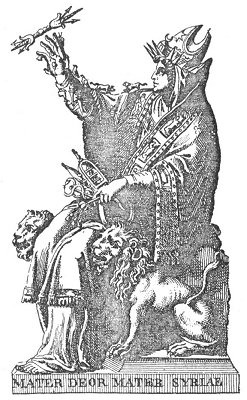
A FEMALE HIEROPHANT OF THE MYSTERIES.
From Montfaucon's Antiquities.
This illustration shows Cybele, here called the Syrian Goddess, in the robes of a hierophant. Montfaucon describes the figure as follows: "Upon her head is an episcopal mitre, adorned on the lower part with towers and pinnacles; over the gate of the city is a crescent, and beneath the circuit of the walls a crown of rays. The Goddess wears a sort of surplice, exactly like the surplice of a priest or bishop; and upon the surplice a tunic, which falls down to the legs; and over all an episcopal cope, with the twelve signs of the Zodiac wrought on the borders. The figure hath a lion on each side, and holds in its left hand a Tympanum, a Sistrum, a Distaff, a Caduceus, and another instrument. In her right hand she holds with her middle finger a thunderbolt, and upon the same am animals, insects, and, as far as we may guess, flowers, fruit, a bow, a quiver, a torch, and a scythe." The whereabouts of the statue is unknown, the copy reproduced by Montfaucon being from drawings by Pirro Ligorio.
In the ancient world, nearly all the secret societies were philosophic and religious. During the mediæval centuries, they were chiefly religious and political, although a few philosophic schools remained. In modern times, secret societies, in the Occidental countries, are largely political or fraternal, although in a few of them, as in Masonry, the ancient religious and philosophic principles still survive.
Space prohibits a detailed discussion of the secret schools. There were literally scores of these ancient cults, with branches in all parts of the Eastern and Western worlds. Some, such as those of Pythagoras and the Hermetists, show a decided Oriental influence, while the Rosicrucians, according to their own proclamations, gained much of their wisdom from Arabian mystics. Although the Mystery schools are usually associated with civilization, there is evidence that the most uncivilized peoples of prehistoric times had a knowledge of them. Natives of distant islands, many in the lowest forms of savagery, have mystic rituals and secret practices which, although primitive, are of a decided Masonic tinge.
THE DRUIDIC MYSTERIES OF BRITAIN AND GAUL
"The original and primitive inhabitants of Britain, at some remote period, revived and reformed their national institutes. Their priest, or instructor, had hitherto been simply named Gwydd, but it was considered to have become necessary to divide this office between the national, or superior, priest and another whose influence [would] be more limited. From henceforth the former became Der-Wydd (Druid), or superior instructor, and [the latter] Go-Wydd, or O-Vydd (Ovate), subordinate instructor; and both went by the general name of Beirdd (Bards), or teachers of wisdom. As the system matured and augmented, the Bardic Order consisted of three classes, the Druids, Beirdd Braint, or privileged Bards, and Ovates." (See Samuel Meyrick and Charles Smith, The Costume of The Original Inhabitants of The British Islands.)
The origin of the word Druid is under dispute. Max Müller believes that, like the Irish word Drui, it means "the men of the oak trees." He further draws attention to the fact that the forest gods and tree deities of the Greeks were called dryades. Some believe the word to be of Teutonic origin; others ascribe it to the Welsh. A few trace it to the Gaelic druidh, which means "a wise man" or "a sorcerer." In Sanskrit the word dru means "timber."
At the time of the Roman conquest, the Druids were thoroughly ensconced in Britain and Gaul. Their power over the people was unquestioned, and there were instances in which armies, about to attack each other, sheathed their swords when ordered to do so by the white-robed Druids. No undertaking of great importance was scatted without the assistance of these patriarchs, who stood as mediators between the gods and men. The Druidic Order is deservedly credited with having had a deep understanding of Nature and her laws. The Encyclopædia Britannica states that geography, physical science, natural theology, and astrology were their favorite studies. The Druids had a fundamental knowledge of medicine, especially the use of herbs and simples. Crude surgical instruments also have been found in England and Ireland. An odd treatise on early British medicine states that every practitioner was expected to have a garden or back yard for the growing of certain herbs necessary to his profession. Eliphas Levi, the celebrated transcendentalist, makes the following significant statement:
"The Druids were priests and physicians, curing by magnetism and charging amylets with their fluidic influence. Their universal remedies were mistletoe and serpents' eggs, because these substances attract the astral light in a special manner. The solemnity with which mistletoe was cut down drew upon this plant the popular confidence and rendered it powerfully magnetic. * * * The progress of magnetism will some day reveal to us the absorbing properties of mistletoe. We shall then understand the secret of those spongy growths which drew the unused virtues of plants and become surcharged with tinctures and savors. Mushrooms, truffles, gall on trees, and the different kinds of mistletoe will be employed with understanding by a medical science, which will be new because it is old * * * but one must not move quicker than science, which recedes that it may advance the further. " (See The History of Magic.)
Not only was the mistletoe sacred as symbolic of the universal medicine, or panacea, but also because of the fact that it grew upon the oak tree. Through the symbol of the oak, the Druids worshiped the Supreme Deity; therefore, anything growing upon that tree was sacred to Him. At certain seasons, according to the positions of the sun, moon, and stars, the Arch-Druid climbed the oak tree and cut the mistletoe with a golden sickle consecrated for that service. The parasitic growth was caught in white cloths provided for the purpose, lest it touch the earth and be polluted by terrestrial vibrations. Usually a sacrifice of a white bull was made under the tree.
The Druids were initiates of a secret school that existed in their midst. This school, which closely resembled the Bacchic and Eleusinian Mysteries of Greece or the Egyptian rites of Isis and Osiris, is justly designated the Druidic Mysteries. There has been much speculation concerning the secret wisdom that the Druids claimed to possess. Their secret teachings were never written, but were communicated orally to specially prepared candidates. Robert Brown, 32°, is of the opinion that the British priests secured their information from Tyrian and Phœnician navigators who, thousands of years before the Christian Era, established colonies in Britain and Gaul while searching for tin. Thomas Maurice, in his Indian Antiquities, discourses at length on Phœnician, Carthaginian, and Greek expeditions to the British Isles for the purpose of procuring tin. Others are of the opinion that the Mysteries as celebrated by the Druids were of Oriental origin, possibly Buddhistic.
The proximity of the British Isles to the lost Atlantis may account for the sun worship which plays an important part in the rituals of Druidism. According to Artemidorus, Ceres and Persephone were worshiped on an island close to Britain with rites and ceremonies similar to those of Samothrace. There is no doubt that the Druidic Pantheon includes a large number of Greek and Roman deities. This greatly amazed Cæsar during his conquest of Britain and Gaul, and caused him to affirm that these tribes adored Mercury, Apollo, Mars, and Jupiter, in a manner similar to that of the Latin countries. It is almost certain that the Druidic Mysteries were not indigenous to Britain or Gaul, but migrated from one of the more ancient civilizations.
The school of the Druids was divided into three distinct parts, and the secret teachings embodied therein are practically the same as the mysteries concealed under the allegories of Blue Lodge Masonry. The lowest of the three divisions was that of Ovate (Ovydd). This was an honorary degree, requiring no special purification or preparation. The Ovates dressed in green, the Druidic color of learning, and were expected to know something about medicine, astronomy, poetry if possible, and sometimes music. An Ovate was an individual admitted to the Druidic Order because of his general excellence and superior knowledge concerning the problems of life.
The second division was that of Bard (Beirdd). Its members were robed in sky-blue, to represent harmony and truth, and to them was assigned the labor of memorizing, at least in part, the twenty thousand verses of Druidic sacred poetry. They were often pictured with the primitive British or Irish harp--an instrument strung with human hair, and having as many strings as there were ribs on one side of the human body. These Bards were often chosen as teachers of candidates seeking entrance into the Druidic Mysteries. Neophytes wore striped robes of blue, green, and white, these being the three sacred colors of the Druidic Order.
The third division was that of Druid (Derwyddon). Its particular labor was to minister to the religious needs of the people. To reach this dignity, the candidate must first become a Bard Braint. The Druids always dressed in white--symbolic of their purity, and the color used by them to symbolize the sun.
In order to reach the exalted position of Arch-Druid, or spiritual head of the organization, it was necessary for a priest to pass through the six successive degrees of the Druidic Order. (The members of the different degrees were differentiated by the colors of their sashes, for all of them wore robes of white.) Some writers are of the opinion that the title of Arch-Druid was hereditary, descending from father to son, but it is more probable that the honor was conferred by ballot election. Its recipient was chosen for his virtues and integrity from the most learned members of the higher Druidic degrees.

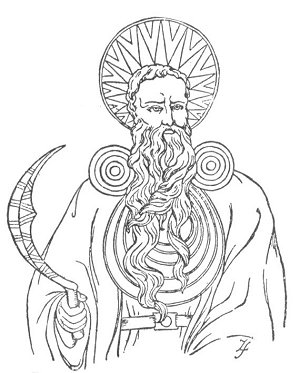
THE ARCH-DRUID IN HIS CEREMONIAL ROBES.
From Wellcome's Ancient Cymric Medicine.
The most striking adornment of the Arch-Druid was the iodhan moran, or breastplate of judgment, which possessed the mysterious Power of strangling any who made an untrue statement while wearing it. Godfrey Higgins states that this breastplate was put on the necks of witnesses to test the veracity of their evidence. The Druidic tiara, or anguinum, its front embossed with a number of points to represent the sun's rays, indicated that the priest was a personification of the rising sun. On the front of his belt the Arch-Druid wore the liath meisicith-¬a magic brooch, or buckle in the center of which was a large white stone. To this was attributed the power of drawing the fire of the gods down from heaven at the priest's command This specially cut stone was a burning glass, by which the sun's rays were concentrated to light the altar fires. The Druids also had other symbolic implements, such as the peculiarly shaped golden sickle with which they cut the mistletoe from the oak, and the cornan, or scepter, in the form of a crescent, symbolic of the sixth day of the increasing moon and also of the Ark of Noah. An early initiate of the Druidic Mysteries related that admission to their midnight ceremony was gained by means of a glass boat, called Cwrwg Gwydrin. This boat symbolized the moon, which, floating upon the waters of eternity, preserved the seeds of living creatures within its boatlike crescent.
According to James Gardner, there were usually two Arch-Druids in Britain, one residing on the Isle of Anglesea and the other on the Isle of Man. Presumably there were others in Gaul. These dignitaries generally carried golden scepters and were crowned with wreaths of oak leaves, symbolic of their authority. The younger members of the Druidic Order were clean-shaven and modestly dressed, but the more aged had long gray beards and wore magnificent golden ornaments. The educational system of the Druids in Britain was superior to that of their colleagues on the Continent, and consequently many of the Gallic youths were sent to the Druidic colleges in Britain for their philosophical instruction and training.
Eliphas Levi states that the Druids lived in strict abstinence, studied the natural sciences, preserved the deepest secrecy, and admitted new members only after long probationary periods. Many of the priests of the order lived in buildings not unlike the monasteries of the modern world. They were associated in groups like ascetics of the Far East. Although celibacy was not demanded of them, few married. Many of the Druids retired from the world and lived as recluses in caves, in rough-stone houses, or in little shacks built in the depths of a forest. Here they prayed and medicated, emerging only to perform their religious duties.
James Freeman Clarke, in his Ten Great Religions, describes the beliefs of the Druids as follows: "The Druids believed in three worlds and in transmigration from one to the other: In a world above this, in which happiness predominated; a world below, of misery; and this present state. This transmigration was to punish and reward and also to purify the soul. In the present world, said they, Good and Evil are so exactly balanced that man has the utmost freedom and is able to choose or reject either. The Welsh Triads tell us there are three objects of metempsychosis: to collect into the soul the properties of all being, to acquire a knowledge of all things, and to get power to conquer evil. There are also, they say, three kinds of knowledge: knowledge of the nature of each thing, of its cause, and its influence. There are three things which continually grow less: darkness, falsehood, and death. There are three which constantly increase: light, life, and truth."
Like nearly all schools of the Mysteries, the teachings of the Druids were divided into two distinct sections. The simpler, a moral code, was taught to all the people, while the deeper, esoteric doctrine was given only to initiated priests. To be admitted to the order, a candidate was required to be of good family and of high moral character. No important secrets were intrusted to him until he had been tempted in many ways and his strength of character severely tried. The Druids taught the people of Britain and Gaul concerning the immortality of the soul. They believed in transmigration and apparently in reincarnation. They borrowed in one life, promising to pay back in the next. They believed in a purgatorial type of hell where they would be purged of their sins, afterward passing on to the happiness of unity with the gods. The Druids taught that all men would be saved, but that some must return to earth many times to learn the lessons of human life and to overcome the inherent evil of their own natures.
Before a candidate was intrusted with the secret doctrines of the Druids, he was bound with a vow of secrecy. These doctrines were imparted only in the depths of forests and in the darkness of caves. In these places, far from the haunts of men, the neophyte was instructed concerning the creation of the universe, the personalities of the gods, the laws of Nature, the secrets of occult medicine, the mysteries of the celestial bodies, and the rudiments of magic and sorcery. The Druids had a great number of feast days. The new and full moon and the sixth day of the moon were sacred periods. It is believed that initiations took place only at the two solstices and the two equinoxes. At dawn of the 25th day of December, the birth of the Sun God was celebrated.
The secret teachings of the Druids are said by some to be tinctured with Pythagorean philosophy. The Druids had a Madonna, or Virgin Mother, with a Child in her arms, who was sacred to their Mysteries; and their Sun God was resurrected at the time of the year corresponding to that at which modern Christians celebrate Easter.
Both the cross and the serpent were sacred to the Druids, who made the former by cutting off all the branches of an oak tree and fastening one of them to the main trunk in the form of the letter T. This oaken cross became symbolic of their superior Deity. They also worshiped the sun, moon, and stars. The moon received their special veneration. Caesar stated that Mercury was one of the chief deities of the Gauls. The Druids are believed to have worshiped Mercury under the similitude of a stone cube. They also had great veneration for the Nature spirits (fairies, gnomes, and undines), little creatures of the forests and rivers to whom many offerings were made. Describing the temples of the Druids, Charles Heckethorn, in The Secret Societies of All Ages & Countries, says:
"Their temples wherein the sacred fire was preserved were generally situate on eminences and in dense groves of oak, and assumed various forms--circular, because a circle was the emblem of the universe; oval, in allusion to the mundane egg, from which issued, according to the traditions of many nations, the universe, or, according to others, our first parents; serpentine, because a serpent was the symbol of Hu, the Druidic Osiris; cruciform, because a cross is an emblem of regeneration; or winged, to represent the motion of the Divine Spirit. * * * Their chief deities were reducible to two--a male and a female, the great father and mother--Hu and Ceridwen, distinguished by the same characteristics as belong to Osiris and Isis, Bacchus and Ceres, or any other supreme god and goddess representing the two principles of all Being."
Godfrey Higgins states that Hu, the Mighty, regarded as the first settler of Britain, came from a place which the Welsh Triads call the Summer Country, the present site of Constantinople. Albert Pike says that the Lost Word of Masonry is concealed in the name of the Druid god Hu. The meager information extant concerning the secret initiations of the Druids indicates a decided similarity between their Mystery school and the schools of Greece and Egypt. Hu, the Sun God, was murdered and, after a number of strange ordeals and mystic rituals, was restored to life.
There were three degrees of the Druidic Mysteries, but few successfully passed them all. The candidate was buried in a coffin, as symbolic of the death of the Sun God. The supreme test, however, was being sent out to sea in an open boat. While undergoing this ordeal, many lost their lives. Taliesin, an ancient scholar, who passed through the Mysteries, describes the initiation of the open boat in Faber's Pagan Idolatry. The few who passed this third degree were said to have been "born again," and were instructed in the secret and hidden truths which the Druid priests had preserved from antiquity. From these initiates were chosen many of the dignitaries of the British religious and political world. (For further details, see Faber's Pagan Idolatry, Albert Pike's Morals and Dogma, and Godfrey Higgins' Celtic Druids.)
THE RITES OF MITHRAS
When the Persian Mysteries immigrated into Southern Europe, they were quickly assimilated by the Latin mind. The cult grew rapidly, especially among the Roman soldiery, and during the Roman wars of conquest the teachings were carried by the legionaries to nearly all parts of Europe. So powerful did the cult of Mithras become that at least one Roman Emperor was initiated into the order, which met in caverns under the city of Rome. Concerning the spread of this Mystery school through different parts of Europe, C. W. King, in his Gnostics and Their Remains, says:
"Mithraic bas-reliefs cut on the faces of rocks or on stone tablets still abound in the countries formerly the western provinces of the Roman Empire; many exist in Germany, still more in France, and in this island (Britain) they have often been discovered on the line of the Picts' Wall and the noted one at Bath."
Alexander Wilder, in his Philosophy and Ethics of the Zoroasters, states that Mithras is the Zend title for the sun, and he is supposed to dwell within that shining orb. Mithras has a male and a female aspect, though not himself androgynous. As Mithras, he is the ford of the sun, powerful and radiant, and most magnificent of the Yazatas (Izads, or Genii, of the sun). As Mithra, this deity represents the feminine principle; the mundane universe is recognized as her symbol. She represents Nature as receptive and terrestrial, and as fruitful only when bathed in the glory of the solar orb. The Mithraic cult is a simplification of the more elaborate teachings of Zarathustra (Zoroaster), the Persian fire magician.

THE GROUND PLAN OF STONEHENGE.
From Maurice's Indian Antiquities.
The Druid temples of places of religious worship were not patterned after those of other nations. Most of their ceremonies were performed at night, either in thick groves of oak trees or around open-air altars built of great uncut stones. How these masses of rock were moved ahs not been satisfactorily explained. The most famous of their altars, a great stone ring of rocks, is Stonehenge, in Southwestern England. This structure, laid out on an astronomical basis, still stands, a wonder of antiquity.
According to the Persians, there coexisted in eternity two principles. The first of these, Ahura-Mazda, or Ormuzd, was the Spirit of Good. From Ormuzd came forth a number of hierarchies of good and beautiful spirits (angels and archangels). The second of these eternally existing principles was called Ahriman. He was also a pure and beautiful spirit, but he later rebelled against Ormuzd, being jealous of his power. This did not occur, however, until after Ormuzd had created light, for previously Ahriman had not been conscious of the existence of Ormuzd. Because of his jealousy and rebellion, Ahriman became the Spirit of Evil. From himself he individualized a host of destructive creatures to injure Ormuzd.
When Ormuzd created the earth, Ahriman entered into its grosser elements. Whenever Ormuzd did a good deed, Ahriman placed the principle of evil within it. At last when Ormuzd created the human race, Ahriman became incarnate in the lower nature of man so that in each personality the Spirit of Good and the Spirit of Evil struggle for control. For 3,000 years Ormuzd ruled the celestial worlds with light and goodness. Then he created man. For another 3,000 years he ruled man with wisdom, and integrity. Then the power of Ahriman began, and the struggle for the soul of man continues through the next period of 3,000 years. During the fourth period of 3,000 years, the power of Ahriman will be destroyed. Good will return to the world again, evil and death will be vanquished, and at last the Spirit of Evil will bow humbly before the throne of Ormuzd. While Ormuzd and Ahriman are struggling for control of the human soul and for supremacy in Nature, Mithras, God of Intelligence, stands as mediator between the two. Many authors have noted the similarity between mercury and Mithras. As the chemical mercury acts as a solvent (according to alchemists), so Mithras seeks to harmonize the two celestial opposites.
There are many points of resemblance between Christianity and the cult of Mithras. One of the reasons for this probably is that the Persian mystics invaded Italy during the first century after Christ and the early history of both cults was closely interwoven. The Encyclopædia Britannica makes the following statement concerning the Mithraic and Christian Mysteries:
"The fraternal and democratic spirit of the first communities, and their humble origin; the identification of the object of adoration with light and the sun; the legends of the shepherds with their gifts and adoration, the flood, and the ark; the representation in art of the fiery chariot, the drawing of water from the rock; the use of bell and candle, holy water and the communion; the sanctification of Sunday and of the 25th of December; the insistence on moral conduct, the emphasis placed on abstinence and self-control; the doctrine of heaven and hell, of primitive revelation, of the mediation of the Logos emanating from the divine, the atoning sacrifice, the constant warfare between good and evil and the final triumph of the former, the immortality of the soul, the last judgment, the resurrection of the flesh and the fiery destruction of the universe--[these] are some of the resemblances which, whether real or only apparent, enabled Mithraism to prolong its resistance to Christianity,"
The rites of Mithras were performed in caves. Porphyry, in his Cave of the Nymphs, states that Zarathustra (Zoroaster) was the first to consecrate a cave to the worship of God, because a cavern was symbolic of the earth, or the lower world of darkness. John P. Lundy, in his Monumental Christianity, describes the cave of Mithras as follows:
"But this cave was adorned with the signs of the zodiac, Cancer and Capricorn. The summer and winter solstices were chiefly conspicuous, as the gates of souls descending into this life, or passing out of it in their ascent to the Gods; Cancer being the gate of descent, and Capricorn of ascent. These are the two avenues of the immortals passing up and down from earth to heaven, and from heaven to earth."
The so-called chair of St. Peter, in Rome, was believed to have been used in one of the pagan Mysteries, possibly that of Mithras, in whose subterranean grottoes the votaries of the Christian Mysteries met in the early days of their faith. In Anacalypsis, Godfrey Higgins writes that in 1662, while cleaning this sacred chair of Bar-Jonas, the Twelve Labors of Hercules were discovered upon it, and that later the French discovered upon the same chair the Mohammedan confession of faith, written in Arabic.
Initiation into the rites of Mithras, like initiation into many other ancient schools of philosophy, apparently consisted of three important degrees. Preparation for these degrees consisted of self-purification, the building up of the intellectual powers, and the control of the animal nature. In the first degree the candidate was given a crown upon the point of a sword and instructed in the mysteries of Mithras' hidden power. Probably he was taught that the golden crown represented his own spiritual nature, which must be objectified and unfolded before he could truly glorify Mithras; for Mithras was his own soul, standing as mediator between Ormuzd, his spirit, and Ahriman, his animal nature. In the second degree he was given the armor of intelligence and purity and sent into the darkness of subterranean pits to fight the beasts of lust, passion, and degeneracy. In the third degree he was given a cape, upon which were drawn or woven the signs of the zodiac and other astronomical symbols. After his initiations were over, he was hailed as one who had risen from the dead, was instructed in the secret teachings of the Persian mystics, and became a full-fledged member of the order. Candidates who successfully passed the Mithraic initiations were called Lions and were marked upon their foreheads with the Egyptian cross. Mithras himself is often pictured with the head of a lion and two pairs of wings. Throughout the entire ritual were repeated references to the birth of Mithras as the Sun God, his sacrifice for man, his death that men might have eternal life, and lastly, his resurrection and the saving of all humanity by his intercession before the throne of Ormuzd. (See Heckethorn.)
While the cult of Mithras did not reach the philosophic heights attained by Zarathustra, its effect upon the civilization of the Western world was far-reaching, for at one time nearly all Europe was converted to its doctrines. Rome, in her intercourse with other nations, inoculated them with her religious principles; and many later institutions have exhibited Mithraic culture. The reference to the "Lion" and the "Grip of the Lion's Paw" in the Master Mason's degree have a strong Mithraic tinge and may easily have originated from this cult. A ladder of seven rungs appears in the Mithraic initiation. Faber is of the opinion that this ladder was originally a pyramid of seven steps. It is possible that the Masonic ladder with seven rungs had its origin in this Mithraic symbol. Women were never permitted to enter the Mithraic Order, but children of the male sex were initiates long before they reached maturity. The refusal to permit women to join the Masonic Order may be based on the esoteric reason given in the secret instructions of the Mithraics. This cult is another excellent example of those secret societies whose legends are largely symbolic representations of the sun and his journey through the houses of the heavens. Mithras, rising from a stone, is merely the sun rising over the horizon, or, as the ancients supposed, out of the horizon, at the vernal equinox.
John O'Neill disputes the theory that Mithras was intended as a solar deity. In The Night of the Gods he writes: "The Avestan Mithra, the yazata of light, has '10,000 eyes, high, with full knowledge (perethuvaedayana), strong, sleepless and ever awake (jaghaurvaunghem).'The supreme god Ahura Mazda also has one Eye, or else it is said that 'with his eyes, the sun, moon and stars, he sees everything.' The theory that Mithra was originally a title of the supreme heavens-god--putting the sun out of court--is the only one that answers all requirements. It will be evident that here we have origins in abundance for the Freemason's Eye and 'its nunquam dormio.'" The reader must nor confuse the Persian Mithra with the Vedic Mitra. According to Alexander Wilder, "The Mithraic rites superseded the Mysteries of Bacchus, and became the foundation of the Gnostic system, which for many centuries prevailed in Asia, Egypt, and even the remote West."

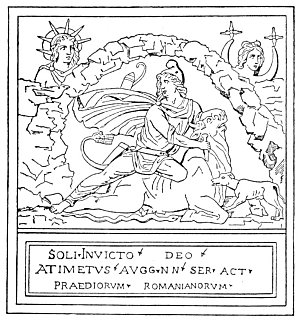
MITHRAS SLAYING THE BULL.
From Lundy's Monumental Christianity.
The most famous sculpturings and reliefs of this prototokos show Mithras kneeling upon the recumbent form of a great bull, into whose throat he is driving a sword. The slaying of the bull signifies that the rays of the sun, symbolized by the sword, release at the vernal equinox the vital essences of the earth--the blood of the bull-¬which, pouring from the wound made by the Sun God, fertilize the seeds of living things. Dogs were held sacred to the cult of Mithras, being symbolic of sincerity and trustworthiness. The Mithraics used the serpent a an emblem of Ahriman, the Spirit of Evil, and water rats were held sacred to him. The bull is esoterically the Constellation of Taurus; the serpent, its opposite in the zodiac, Scorpio; the sun, Mithras, entering into the side of the bull, slays the celestial creature and nourishes the universe with its blood.
 THE BIRTH OF MITHRAS.
From Montfaucon's Antiquities
Mithras was born out of a rock, which, breaking open, permitted him to emerge. This occurred in the darkness of a subterranean chamber. The Church of the Nativity at Bethlehem confirms the theory that Jesus was born in a grotto, or cave. According to Dupuis, Mithras was put to death by crucifixion and rose again on the third day.
There are, however, but few mature minds in the world; and thus it was that the philosophic-religious doctrines of the pagans were divided to meet the needs of these two fundamental groups of human intellect--one philosophic, the other incapable of appreciating the deeper mysteries of life. To the discerning few were revealed the esoteric, or spiritual, teachings, while the unqualified many received only the literal, or exoteric, interpretations. In order to make simple the great truths of Nature and the abstract principles of natural law, the vital forces of the universe were personified, becoming the gods and goddesses of the ancient mythologies. While the ignorant multitudes brought their offerings to the altars of Priapus and Pan (deities representing the procreative energies), the wise recognized in these marble statues only symbolic concretions of great abstract truths.
In all cities of the ancient world were temples for public worship and offering. In every community also were philosophers and mystics, deeply versed in Nature's lore. These individuals were usually banded together, forming seclusive philosophic and religious schools. The more important of these groups were known as the Mysteries. Many of the great minds of antiquity were initiated into these secret fraternities by strange and mysterious rites, some of which were extremely cruel. Alexander Wilder defines the Mysteries as "Sacred dramas performed at stated periods. The most celebrated were those of Isis, Sabazius, Cybele, and Eleusis." After being admitted, the initiates were instructed in the secret wisdom which had been preserved for ages. Plato, an initiate of one of these sacred orders, was severely criticized because in his writings he revealed to the public many of the secret philosophic principles of the Mysteries.
Every pagan nation had (and has) not only its state religion, but another into which the philosophic elect alone have gained entrance. Many of these ancient cults vanished from the earth without revealing their secrets, but a few have survived the test of ages and their mysterious symbols are still preserved. Much of the ritualism of Freemasonry is based on the trials to which candidates were subjected by the ancient hierophants before the keys of wisdom were entrusted to them.
Few realize the extent to which the ancient secret schools influenced contemporary intellects and, through those minds, posterity. Robert Macoy, 33°, in his General History of Freemasonry, pays a magnificent tribute to the part played by the ancient Mysteries in the rearing of the edifice of human culture. He says, in part: "It appears that all the perfection of civilization, and all the advancement made in philosophy, science, and art among the ancients are due to those institutions which, under the veil of mystery, sought to illustrate the sublimest truths of religion, morality, and virtue, and impress them on the hearts of their disciples.* * * Their chief object was to teach the doctrine of one God, the resurrection of man to eternal life, the dignity of the human soul, and to lead the people to see the shadow of the deity, in the beauty, magnificence, and splendor of the universe."
With the decline of virtue, which has preceded the destruction of every nation of history, the Mysteries became perverted. Sorcery took the place of the divine magic. Indescribable practices (such as the Bacchanalia) were introduced, and perversion ruled supreme; for no institution can be any better than the members of which it is composed. In despair, the few who were true sought to preserve the secret doctrines from oblivion. In some cases they succeeded, but more often the arcanum was lost and only the empty shell of the Mysteries remained.
Thomas Taylor has written, "Man is naturally a religious animal." From the earliest dawning of his consciousness, man has worshiped and revered things as symbolic of the invisible, omnipresent, indescribable Thing, concerning which he could discover practically nothing. The pagan Mysteries opposed the Christians during the early centuries of their church, declaring that the new faith (Christianity) did not demand virtue and integrity as requisites for salvation. Celsus expressed himself on the subject in the following caustic terms:
"That I do not, however, accuse the Christians more bitterly than truth compels, may be conjectured from hence, that the cryers who call men to other mysteries proclaim as follows: 'Let him approach whose hands are pure, and whose words are wise.' And again, others proclaim: 'Let him approach who is pure from all wickedness, whose soul is not conscious of any evil, and who leads a just and upright life.' And these things are proclaimed by those who promise a purification from error. Let us now hear who those are that are called to the Christian mysteries: Whoever is a sinner, whoever is unwise, whoever is a fool, and whoever, in short, is miserable, him the kingdom of God will receive. Do you not, therefore, call a sinner, an unjust man, a thief, a housebreaker, a wizard, one who is sacrilegious, and a robber of sepulchres? What other persons would the cryer nominate, who should call robbers together?"
It was not the true faith of the early Christian mystics that Celsus attacked, but the false forms that were creeping in even during his day. The ideals of early Christianity were based upon the high moral standards of the pagan Mysteries, and the first Christians who met under the city of Rome used as their places of worship the subterranean temples of Mithras, from whose cult has been borrowed much of the sacerdotalism of the modem church.
The ancient philosophers believed that no man could live intelligently who did not have a fundamental knowledge of Nature and her laws. Before man can obey, he must understand, and the Mysteries were devoted to instructing man concerning the operation of divine law in the terrestrial sphere. Few of the early cults actually worshiped anthropomorphic deities, although their symbolism might lead one to believe they did. They were moralistic rather than religionistic; philosophic rather than theologic. They taught man to use his faculties more intelligently, to be patient in the face of adversity, to be courageous when confronted by danger, to be true in the midst of temptation, and, most of all, to view a worthy life as the most acceptable sacrifice to God, and his body as an altar sacred to the Deity.
Sun worship played an important part in nearly all the early pagan Mysteries. This indicates the probability of their Atlantean origin, for the people of Atlantis were sun worshipers. The Solar Deity was usually personified as a beautiful youth, with long golden hair to symbolize the rays of the sun. This golden Sun God was slain by wicked ruffians, who personified the evil principle of the universe. By means of certain rituals and ceremonies, symbolic of purification and regeneration, this wonderful God of Good was brought back to life and became the Savior of His people. The secret processes whereby He was resurrected symbolized those cultures by means of which man is able to overcome his lower nature, master his appetites, and give expression to the higher side of himself. The Mysteries were organized for the purpose of assisting the struggling human creature to reawaken the spiritual powers which, surrounded by the flaming ring of lust and degeneracy, lay asleep within his soul. In other words, man was offered a way by which he could regain his lost estate. (See Wagner's Siegfried.)

A FEMALE HIEROPHANT OF THE MYSTERIES.
From Montfaucon's Antiquities.
This illustration shows Cybele, here called the Syrian Goddess, in the robes of a hierophant. Montfaucon describes the figure as follows: "Upon her head is an episcopal mitre, adorned on the lower part with towers and pinnacles; over the gate of the city is a crescent, and beneath the circuit of the walls a crown of rays. The Goddess wears a sort of surplice, exactly like the surplice of a priest or bishop; and upon the surplice a tunic, which falls down to the legs; and over all an episcopal cope, with the twelve signs of the Zodiac wrought on the borders. The figure hath a lion on each side, and holds in its left hand a Tympanum, a Sistrum, a Distaff, a Caduceus, and another instrument. In her right hand she holds with her middle finger a thunderbolt, and upon the same am animals, insects, and, as far as we may guess, flowers, fruit, a bow, a quiver, a torch, and a scythe." The whereabouts of the statue is unknown, the copy reproduced by Montfaucon being from drawings by Pirro Ligorio.
In the ancient world, nearly all the secret societies were philosophic and religious. During the mediæval centuries, they were chiefly religious and political, although a few philosophic schools remained. In modern times, secret societies, in the Occidental countries, are largely political or fraternal, although in a few of them, as in Masonry, the ancient religious and philosophic principles still survive.
Space prohibits a detailed discussion of the secret schools. There were literally scores of these ancient cults, with branches in all parts of the Eastern and Western worlds. Some, such as those of Pythagoras and the Hermetists, show a decided Oriental influence, while the Rosicrucians, according to their own proclamations, gained much of their wisdom from Arabian mystics. Although the Mystery schools are usually associated with civilization, there is evidence that the most uncivilized peoples of prehistoric times had a knowledge of them. Natives of distant islands, many in the lowest forms of savagery, have mystic rituals and secret practices which, although primitive, are of a decided Masonic tinge.
THE DRUIDIC MYSTERIES OF BRITAIN AND GAUL
"The original and primitive inhabitants of Britain, at some remote period, revived and reformed their national institutes. Their priest, or instructor, had hitherto been simply named Gwydd, but it was considered to have become necessary to divide this office between the national, or superior, priest and another whose influence [would] be more limited. From henceforth the former became Der-Wydd (Druid), or superior instructor, and [the latter] Go-Wydd, or O-Vydd (Ovate), subordinate instructor; and both went by the general name of Beirdd (Bards), or teachers of wisdom. As the system matured and augmented, the Bardic Order consisted of three classes, the Druids, Beirdd Braint, or privileged Bards, and Ovates." (See Samuel Meyrick and Charles Smith, The Costume of The Original Inhabitants of The British Islands.)
The origin of the word Druid is under dispute. Max Müller believes that, like the Irish word Drui, it means "the men of the oak trees." He further draws attention to the fact that the forest gods and tree deities of the Greeks were called dryades. Some believe the word to be of Teutonic origin; others ascribe it to the Welsh. A few trace it to the Gaelic druidh, which means "a wise man" or "a sorcerer." In Sanskrit the word dru means "timber."
At the time of the Roman conquest, the Druids were thoroughly ensconced in Britain and Gaul. Their power over the people was unquestioned, and there were instances in which armies, about to attack each other, sheathed their swords when ordered to do so by the white-robed Druids. No undertaking of great importance was scatted without the assistance of these patriarchs, who stood as mediators between the gods and men. The Druidic Order is deservedly credited with having had a deep understanding of Nature and her laws. The Encyclopædia Britannica states that geography, physical science, natural theology, and astrology were their favorite studies. The Druids had a fundamental knowledge of medicine, especially the use of herbs and simples. Crude surgical instruments also have been found in England and Ireland. An odd treatise on early British medicine states that every practitioner was expected to have a garden or back yard for the growing of certain herbs necessary to his profession. Eliphas Levi, the celebrated transcendentalist, makes the following significant statement:
"The Druids were priests and physicians, curing by magnetism and charging amylets with their fluidic influence. Their universal remedies were mistletoe and serpents' eggs, because these substances attract the astral light in a special manner. The solemnity with which mistletoe was cut down drew upon this plant the popular confidence and rendered it powerfully magnetic. * * * The progress of magnetism will some day reveal to us the absorbing properties of mistletoe. We shall then understand the secret of those spongy growths which drew the unused virtues of plants and become surcharged with tinctures and savors. Mushrooms, truffles, gall on trees, and the different kinds of mistletoe will be employed with understanding by a medical science, which will be new because it is old * * * but one must not move quicker than science, which recedes that it may advance the further. " (See The History of Magic.)
Not only was the mistletoe sacred as symbolic of the universal medicine, or panacea, but also because of the fact that it grew upon the oak tree. Through the symbol of the oak, the Druids worshiped the Supreme Deity; therefore, anything growing upon that tree was sacred to Him. At certain seasons, according to the positions of the sun, moon, and stars, the Arch-Druid climbed the oak tree and cut the mistletoe with a golden sickle consecrated for that service. The parasitic growth was caught in white cloths provided for the purpose, lest it touch the earth and be polluted by terrestrial vibrations. Usually a sacrifice of a white bull was made under the tree.
The Druids were initiates of a secret school that existed in their midst. This school, which closely resembled the Bacchic and Eleusinian Mysteries of Greece or the Egyptian rites of Isis and Osiris, is justly designated the Druidic Mysteries. There has been much speculation concerning the secret wisdom that the Druids claimed to possess. Their secret teachings were never written, but were communicated orally to specially prepared candidates. Robert Brown, 32°, is of the opinion that the British priests secured their information from Tyrian and Phœnician navigators who, thousands of years before the Christian Era, established colonies in Britain and Gaul while searching for tin. Thomas Maurice, in his Indian Antiquities, discourses at length on Phœnician, Carthaginian, and Greek expeditions to the British Isles for the purpose of procuring tin. Others are of the opinion that the Mysteries as celebrated by the Druids were of Oriental origin, possibly Buddhistic.
The proximity of the British Isles to the lost Atlantis may account for the sun worship which plays an important part in the rituals of Druidism. According to Artemidorus, Ceres and Persephone were worshiped on an island close to Britain with rites and ceremonies similar to those of Samothrace. There is no doubt that the Druidic Pantheon includes a large number of Greek and Roman deities. This greatly amazed Cæsar during his conquest of Britain and Gaul, and caused him to affirm that these tribes adored Mercury, Apollo, Mars, and Jupiter, in a manner similar to that of the Latin countries. It is almost certain that the Druidic Mysteries were not indigenous to Britain or Gaul, but migrated from one of the more ancient civilizations.
The school of the Druids was divided into three distinct parts, and the secret teachings embodied therein are practically the same as the mysteries concealed under the allegories of Blue Lodge Masonry. The lowest of the three divisions was that of Ovate (Ovydd). This was an honorary degree, requiring no special purification or preparation. The Ovates dressed in green, the Druidic color of learning, and were expected to know something about medicine, astronomy, poetry if possible, and sometimes music. An Ovate was an individual admitted to the Druidic Order because of his general excellence and superior knowledge concerning the problems of life.
The second division was that of Bard (Beirdd). Its members were robed in sky-blue, to represent harmony and truth, and to them was assigned the labor of memorizing, at least in part, the twenty thousand verses of Druidic sacred poetry. They were often pictured with the primitive British or Irish harp--an instrument strung with human hair, and having as many strings as there were ribs on one side of the human body. These Bards were often chosen as teachers of candidates seeking entrance into the Druidic Mysteries. Neophytes wore striped robes of blue, green, and white, these being the three sacred colors of the Druidic Order.
The third division was that of Druid (Derwyddon). Its particular labor was to minister to the religious needs of the people. To reach this dignity, the candidate must first become a Bard Braint. The Druids always dressed in white--symbolic of their purity, and the color used by them to symbolize the sun.
In order to reach the exalted position of Arch-Druid, or spiritual head of the organization, it was necessary for a priest to pass through the six successive degrees of the Druidic Order. (The members of the different degrees were differentiated by the colors of their sashes, for all of them wore robes of white.) Some writers are of the opinion that the title of Arch-Druid was hereditary, descending from father to son, but it is more probable that the honor was conferred by ballot election. Its recipient was chosen for his virtues and integrity from the most learned members of the higher Druidic degrees.
THE ARCH-DRUID IN HIS CEREMONIAL ROBES.
From Wellcome's Ancient Cymric Medicine.
The most striking adornment of the Arch-Druid was the iodhan moran, or breastplate of judgment, which possessed the mysterious Power of strangling any who made an untrue statement while wearing it. Godfrey Higgins states that this breastplate was put on the necks of witnesses to test the veracity of their evidence. The Druidic tiara, or anguinum, its front embossed with a number of points to represent the sun's rays, indicated that the priest was a personification of the rising sun. On the front of his belt the Arch-Druid wore the liath meisicith-¬a magic brooch, or buckle in the center of which was a large white stone. To this was attributed the power of drawing the fire of the gods down from heaven at the priest's command This specially cut stone was a burning glass, by which the sun's rays were concentrated to light the altar fires. The Druids also had other symbolic implements, such as the peculiarly shaped golden sickle with which they cut the mistletoe from the oak, and the cornan, or scepter, in the form of a crescent, symbolic of the sixth day of the increasing moon and also of the Ark of Noah. An early initiate of the Druidic Mysteries related that admission to their midnight ceremony was gained by means of a glass boat, called Cwrwg Gwydrin. This boat symbolized the moon, which, floating upon the waters of eternity, preserved the seeds of living creatures within its boatlike crescent.
According to James Gardner, there were usually two Arch-Druids in Britain, one residing on the Isle of Anglesea and the other on the Isle of Man. Presumably there were others in Gaul. These dignitaries generally carried golden scepters and were crowned with wreaths of oak leaves, symbolic of their authority. The younger members of the Druidic Order were clean-shaven and modestly dressed, but the more aged had long gray beards and wore magnificent golden ornaments. The educational system of the Druids in Britain was superior to that of their colleagues on the Continent, and consequently many of the Gallic youths were sent to the Druidic colleges in Britain for their philosophical instruction and training.
Eliphas Levi states that the Druids lived in strict abstinence, studied the natural sciences, preserved the deepest secrecy, and admitted new members only after long probationary periods. Many of the priests of the order lived in buildings not unlike the monasteries of the modern world. They were associated in groups like ascetics of the Far East. Although celibacy was not demanded of them, few married. Many of the Druids retired from the world and lived as recluses in caves, in rough-stone houses, or in little shacks built in the depths of a forest. Here they prayed and medicated, emerging only to perform their religious duties.
James Freeman Clarke, in his Ten Great Religions, describes the beliefs of the Druids as follows: "The Druids believed in three worlds and in transmigration from one to the other: In a world above this, in which happiness predominated; a world below, of misery; and this present state. This transmigration was to punish and reward and also to purify the soul. In the present world, said they, Good and Evil are so exactly balanced that man has the utmost freedom and is able to choose or reject either. The Welsh Triads tell us there are three objects of metempsychosis: to collect into the soul the properties of all being, to acquire a knowledge of all things, and to get power to conquer evil. There are also, they say, three kinds of knowledge: knowledge of the nature of each thing, of its cause, and its influence. There are three things which continually grow less: darkness, falsehood, and death. There are three which constantly increase: light, life, and truth."
Like nearly all schools of the Mysteries, the teachings of the Druids were divided into two distinct sections. The simpler, a moral code, was taught to all the people, while the deeper, esoteric doctrine was given only to initiated priests. To be admitted to the order, a candidate was required to be of good family and of high moral character. No important secrets were intrusted to him until he had been tempted in many ways and his strength of character severely tried. The Druids taught the people of Britain and Gaul concerning the immortality of the soul. They believed in transmigration and apparently in reincarnation. They borrowed in one life, promising to pay back in the next. They believed in a purgatorial type of hell where they would be purged of their sins, afterward passing on to the happiness of unity with the gods. The Druids taught that all men would be saved, but that some must return to earth many times to learn the lessons of human life and to overcome the inherent evil of their own natures.
Before a candidate was intrusted with the secret doctrines of the Druids, he was bound with a vow of secrecy. These doctrines were imparted only in the depths of forests and in the darkness of caves. In these places, far from the haunts of men, the neophyte was instructed concerning the creation of the universe, the personalities of the gods, the laws of Nature, the secrets of occult medicine, the mysteries of the celestial bodies, and the rudiments of magic and sorcery. The Druids had a great number of feast days. The new and full moon and the sixth day of the moon were sacred periods. It is believed that initiations took place only at the two solstices and the two equinoxes. At dawn of the 25th day of December, the birth of the Sun God was celebrated.
The secret teachings of the Druids are said by some to be tinctured with Pythagorean philosophy. The Druids had a Madonna, or Virgin Mother, with a Child in her arms, who was sacred to their Mysteries; and their Sun God was resurrected at the time of the year corresponding to that at which modern Christians celebrate Easter.
Both the cross and the serpent were sacred to the Druids, who made the former by cutting off all the branches of an oak tree and fastening one of them to the main trunk in the form of the letter T. This oaken cross became symbolic of their superior Deity. They also worshiped the sun, moon, and stars. The moon received their special veneration. Caesar stated that Mercury was one of the chief deities of the Gauls. The Druids are believed to have worshiped Mercury under the similitude of a stone cube. They also had great veneration for the Nature spirits (fairies, gnomes, and undines), little creatures of the forests and rivers to whom many offerings were made. Describing the temples of the Druids, Charles Heckethorn, in The Secret Societies of All Ages & Countries, says:
"Their temples wherein the sacred fire was preserved were generally situate on eminences and in dense groves of oak, and assumed various forms--circular, because a circle was the emblem of the universe; oval, in allusion to the mundane egg, from which issued, according to the traditions of many nations, the universe, or, according to others, our first parents; serpentine, because a serpent was the symbol of Hu, the Druidic Osiris; cruciform, because a cross is an emblem of regeneration; or winged, to represent the motion of the Divine Spirit. * * * Their chief deities were reducible to two--a male and a female, the great father and mother--Hu and Ceridwen, distinguished by the same characteristics as belong to Osiris and Isis, Bacchus and Ceres, or any other supreme god and goddess representing the two principles of all Being."
Godfrey Higgins states that Hu, the Mighty, regarded as the first settler of Britain, came from a place which the Welsh Triads call the Summer Country, the present site of Constantinople. Albert Pike says that the Lost Word of Masonry is concealed in the name of the Druid god Hu. The meager information extant concerning the secret initiations of the Druids indicates a decided similarity between their Mystery school and the schools of Greece and Egypt. Hu, the Sun God, was murdered and, after a number of strange ordeals and mystic rituals, was restored to life.
There were three degrees of the Druidic Mysteries, but few successfully passed them all. The candidate was buried in a coffin, as symbolic of the death of the Sun God. The supreme test, however, was being sent out to sea in an open boat. While undergoing this ordeal, many lost their lives. Taliesin, an ancient scholar, who passed through the Mysteries, describes the initiation of the open boat in Faber's Pagan Idolatry. The few who passed this third degree were said to have been "born again," and were instructed in the secret and hidden truths which the Druid priests had preserved from antiquity. From these initiates were chosen many of the dignitaries of the British religious and political world. (For further details, see Faber's Pagan Idolatry, Albert Pike's Morals and Dogma, and Godfrey Higgins' Celtic Druids.)
THE RITES OF MITHRAS
When the Persian Mysteries immigrated into Southern Europe, they were quickly assimilated by the Latin mind. The cult grew rapidly, especially among the Roman soldiery, and during the Roman wars of conquest the teachings were carried by the legionaries to nearly all parts of Europe. So powerful did the cult of Mithras become that at least one Roman Emperor was initiated into the order, which met in caverns under the city of Rome. Concerning the spread of this Mystery school through different parts of Europe, C. W. King, in his Gnostics and Their Remains, says:
"Mithraic bas-reliefs cut on the faces of rocks or on stone tablets still abound in the countries formerly the western provinces of the Roman Empire; many exist in Germany, still more in France, and in this island (Britain) they have often been discovered on the line of the Picts' Wall and the noted one at Bath."
Alexander Wilder, in his Philosophy and Ethics of the Zoroasters, states that Mithras is the Zend title for the sun, and he is supposed to dwell within that shining orb. Mithras has a male and a female aspect, though not himself androgynous. As Mithras, he is the ford of the sun, powerful and radiant, and most magnificent of the Yazatas (Izads, or Genii, of the sun). As Mithra, this deity represents the feminine principle; the mundane universe is recognized as her symbol. She represents Nature as receptive and terrestrial, and as fruitful only when bathed in the glory of the solar orb. The Mithraic cult is a simplification of the more elaborate teachings of Zarathustra (Zoroaster), the Persian fire magician.

THE GROUND PLAN OF STONEHENGE.
From Maurice's Indian Antiquities.
The Druid temples of places of religious worship were not patterned after those of other nations. Most of their ceremonies were performed at night, either in thick groves of oak trees or around open-air altars built of great uncut stones. How these masses of rock were moved ahs not been satisfactorily explained. The most famous of their altars, a great stone ring of rocks, is Stonehenge, in Southwestern England. This structure, laid out on an astronomical basis, still stands, a wonder of antiquity.
According to the Persians, there coexisted in eternity two principles. The first of these, Ahura-Mazda, or Ormuzd, was the Spirit of Good. From Ormuzd came forth a number of hierarchies of good and beautiful spirits (angels and archangels). The second of these eternally existing principles was called Ahriman. He was also a pure and beautiful spirit, but he later rebelled against Ormuzd, being jealous of his power. This did not occur, however, until after Ormuzd had created light, for previously Ahriman had not been conscious of the existence of Ormuzd. Because of his jealousy and rebellion, Ahriman became the Spirit of Evil. From himself he individualized a host of destructive creatures to injure Ormuzd.
When Ormuzd created the earth, Ahriman entered into its grosser elements. Whenever Ormuzd did a good deed, Ahriman placed the principle of evil within it. At last when Ormuzd created the human race, Ahriman became incarnate in the lower nature of man so that in each personality the Spirit of Good and the Spirit of Evil struggle for control. For 3,000 years Ormuzd ruled the celestial worlds with light and goodness. Then he created man. For another 3,000 years he ruled man with wisdom, and integrity. Then the power of Ahriman began, and the struggle for the soul of man continues through the next period of 3,000 years. During the fourth period of 3,000 years, the power of Ahriman will be destroyed. Good will return to the world again, evil and death will be vanquished, and at last the Spirit of Evil will bow humbly before the throne of Ormuzd. While Ormuzd and Ahriman are struggling for control of the human soul and for supremacy in Nature, Mithras, God of Intelligence, stands as mediator between the two. Many authors have noted the similarity between mercury and Mithras. As the chemical mercury acts as a solvent (according to alchemists), so Mithras seeks to harmonize the two celestial opposites.
There are many points of resemblance between Christianity and the cult of Mithras. One of the reasons for this probably is that the Persian mystics invaded Italy during the first century after Christ and the early history of both cults was closely interwoven. The Encyclopædia Britannica makes the following statement concerning the Mithraic and Christian Mysteries:
"The fraternal and democratic spirit of the first communities, and their humble origin; the identification of the object of adoration with light and the sun; the legends of the shepherds with their gifts and adoration, the flood, and the ark; the representation in art of the fiery chariot, the drawing of water from the rock; the use of bell and candle, holy water and the communion; the sanctification of Sunday and of the 25th of December; the insistence on moral conduct, the emphasis placed on abstinence and self-control; the doctrine of heaven and hell, of primitive revelation, of the mediation of the Logos emanating from the divine, the atoning sacrifice, the constant warfare between good and evil and the final triumph of the former, the immortality of the soul, the last judgment, the resurrection of the flesh and the fiery destruction of the universe--[these] are some of the resemblances which, whether real or only apparent, enabled Mithraism to prolong its resistance to Christianity,"
The rites of Mithras were performed in caves. Porphyry, in his Cave of the Nymphs, states that Zarathustra (Zoroaster) was the first to consecrate a cave to the worship of God, because a cavern was symbolic of the earth, or the lower world of darkness. John P. Lundy, in his Monumental Christianity, describes the cave of Mithras as follows:
"But this cave was adorned with the signs of the zodiac, Cancer and Capricorn. The summer and winter solstices were chiefly conspicuous, as the gates of souls descending into this life, or passing out of it in their ascent to the Gods; Cancer being the gate of descent, and Capricorn of ascent. These are the two avenues of the immortals passing up and down from earth to heaven, and from heaven to earth."
The so-called chair of St. Peter, in Rome, was believed to have been used in one of the pagan Mysteries, possibly that of Mithras, in whose subterranean grottoes the votaries of the Christian Mysteries met in the early days of their faith. In Anacalypsis, Godfrey Higgins writes that in 1662, while cleaning this sacred chair of Bar-Jonas, the Twelve Labors of Hercules were discovered upon it, and that later the French discovered upon the same chair the Mohammedan confession of faith, written in Arabic.
Initiation into the rites of Mithras, like initiation into many other ancient schools of philosophy, apparently consisted of three important degrees. Preparation for these degrees consisted of self-purification, the building up of the intellectual powers, and the control of the animal nature. In the first degree the candidate was given a crown upon the point of a sword and instructed in the mysteries of Mithras' hidden power. Probably he was taught that the golden crown represented his own spiritual nature, which must be objectified and unfolded before he could truly glorify Mithras; for Mithras was his own soul, standing as mediator between Ormuzd, his spirit, and Ahriman, his animal nature. In the second degree he was given the armor of intelligence and purity and sent into the darkness of subterranean pits to fight the beasts of lust, passion, and degeneracy. In the third degree he was given a cape, upon which were drawn or woven the signs of the zodiac and other astronomical symbols. After his initiations were over, he was hailed as one who had risen from the dead, was instructed in the secret teachings of the Persian mystics, and became a full-fledged member of the order. Candidates who successfully passed the Mithraic initiations were called Lions and were marked upon their foreheads with the Egyptian cross. Mithras himself is often pictured with the head of a lion and two pairs of wings. Throughout the entire ritual were repeated references to the birth of Mithras as the Sun God, his sacrifice for man, his death that men might have eternal life, and lastly, his resurrection and the saving of all humanity by his intercession before the throne of Ormuzd. (See Heckethorn.)
While the cult of Mithras did not reach the philosophic heights attained by Zarathustra, its effect upon the civilization of the Western world was far-reaching, for at one time nearly all Europe was converted to its doctrines. Rome, in her intercourse with other nations, inoculated them with her religious principles; and many later institutions have exhibited Mithraic culture. The reference to the "Lion" and the "Grip of the Lion's Paw" in the Master Mason's degree have a strong Mithraic tinge and may easily have originated from this cult. A ladder of seven rungs appears in the Mithraic initiation. Faber is of the opinion that this ladder was originally a pyramid of seven steps. It is possible that the Masonic ladder with seven rungs had its origin in this Mithraic symbol. Women were never permitted to enter the Mithraic Order, but children of the male sex were initiates long before they reached maturity. The refusal to permit women to join the Masonic Order may be based on the esoteric reason given in the secret instructions of the Mithraics. This cult is another excellent example of those secret societies whose legends are largely symbolic representations of the sun and his journey through the houses of the heavens. Mithras, rising from a stone, is merely the sun rising over the horizon, or, as the ancients supposed, out of the horizon, at the vernal equinox.
John O'Neill disputes the theory that Mithras was intended as a solar deity. In The Night of the Gods he writes: "The Avestan Mithra, the yazata of light, has '10,000 eyes, high, with full knowledge (perethuvaedayana), strong, sleepless and ever awake (jaghaurvaunghem).'The supreme god Ahura Mazda also has one Eye, or else it is said that 'with his eyes, the sun, moon and stars, he sees everything.' The theory that Mithra was originally a title of the supreme heavens-god--putting the sun out of court--is the only one that answers all requirements. It will be evident that here we have origins in abundance for the Freemason's Eye and 'its nunquam dormio.'" The reader must nor confuse the Persian Mithra with the Vedic Mitra. According to Alexander Wilder, "The Mithraic rites superseded the Mysteries of Bacchus, and became the foundation of the Gnostic system, which for many centuries prevailed in Asia, Egypt, and even the remote West."
MITHRAS SLAYING THE BULL.
From Lundy's Monumental Christianity.
The most famous sculpturings and reliefs of this prototokos show Mithras kneeling upon the recumbent form of a great bull, into whose throat he is driving a sword. The slaying of the bull signifies that the rays of the sun, symbolized by the sword, release at the vernal equinox the vital essences of the earth--the blood of the bull-¬which, pouring from the wound made by the Sun God, fertilize the seeds of living things. Dogs were held sacred to the cult of Mithras, being symbolic of sincerity and trustworthiness. The Mithraics used the serpent a an emblem of Ahriman, the Spirit of Evil, and water rats were held sacred to him. The bull is esoterically the Constellation of Taurus; the serpent, its opposite in the zodiac, Scorpio; the sun, Mithras, entering into the side of the bull, slays the celestial creature and nourishes the universe with its blood.
 THE BIRTH OF MITHRAS.
From Montfaucon's Antiquities
Mithras was born out of a rock, which, breaking open, permitted him to emerge. This occurred in the darkness of a subterranean chamber. The Church of the Nativity at Bethlehem confirms the theory that Jesus was born in a grotto, or cave. According to Dupuis, Mithras was put to death by crucifixion and rose again on the third day.